


Notre domaine lavandicole : Le Château du Bois Lagarde d'Apt, Coustellet, Cabrières-d'Avignon Le Château du Bois
At the origin of the museum: the Château du Bois Provence estate
Le Château du Bois is the name of the Lincelé family's fine lavender estate
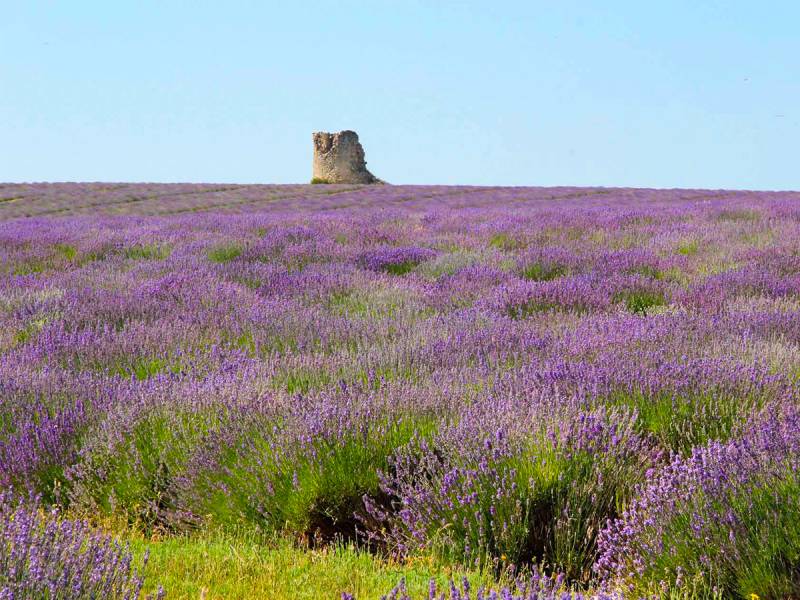
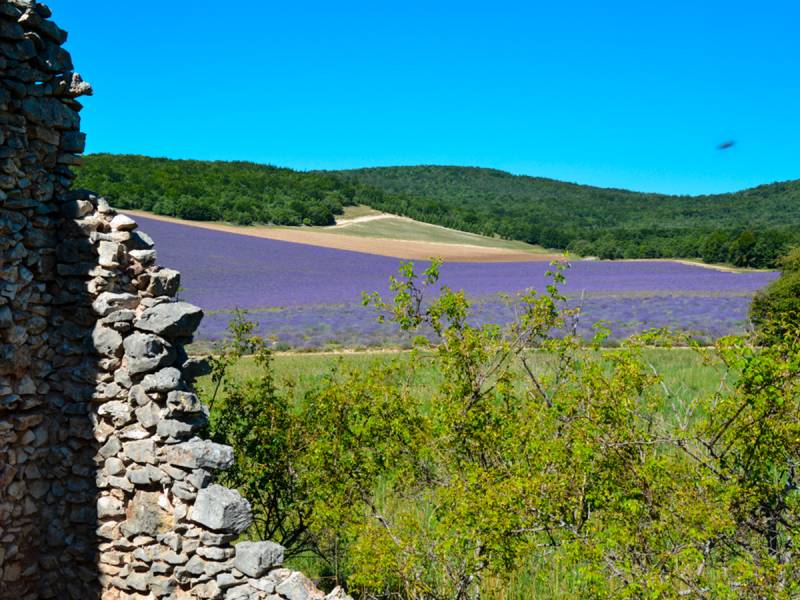
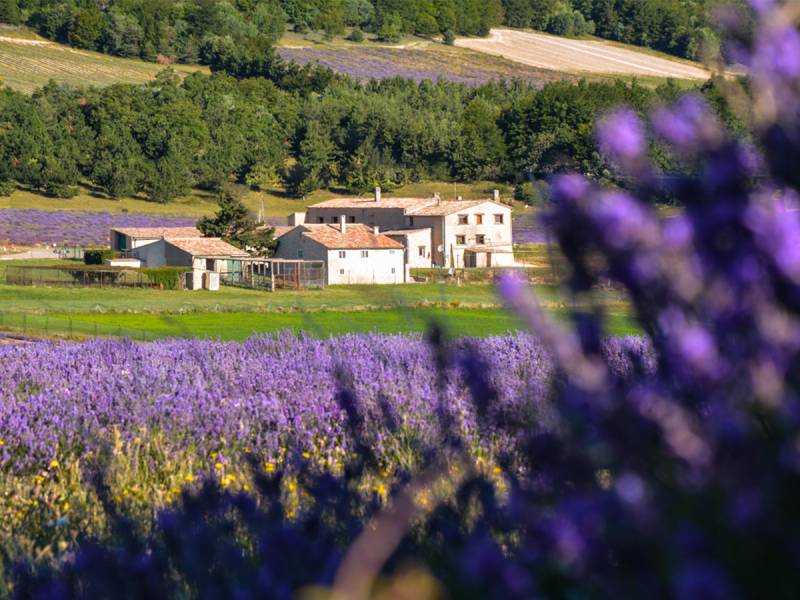
with 110 hectares of fine lavender fields cultivated using environmentally respectful methods. In a sensitive ecosystem at 1,100 metres altitude in the dry mountains of Haute-Provence, biodiversity is preserved across 200 hectares of woodland and forest and 40 hectares of moorland. The estate also houses a distillery producing 100% pure and natural AOP fine lavender essential oil from Haute-Provence, used exclusively for the brand that bears the name "Le Château du Bois Provence".
Agricultural methods have always been thoughtful, carefully following the plant's natural evolution: from seed to flower, from cutting to traditional distillation.
Championing an exceptional lavender
We grow exclusively Lavandula angustifolia P. Miller, also known as true lavender, fine lavender or population lavender.
Each plant grows from a unique seed and differs from its neighbours. These differences are especially noticeable in the quality and olfactory complexity of the essential oils.
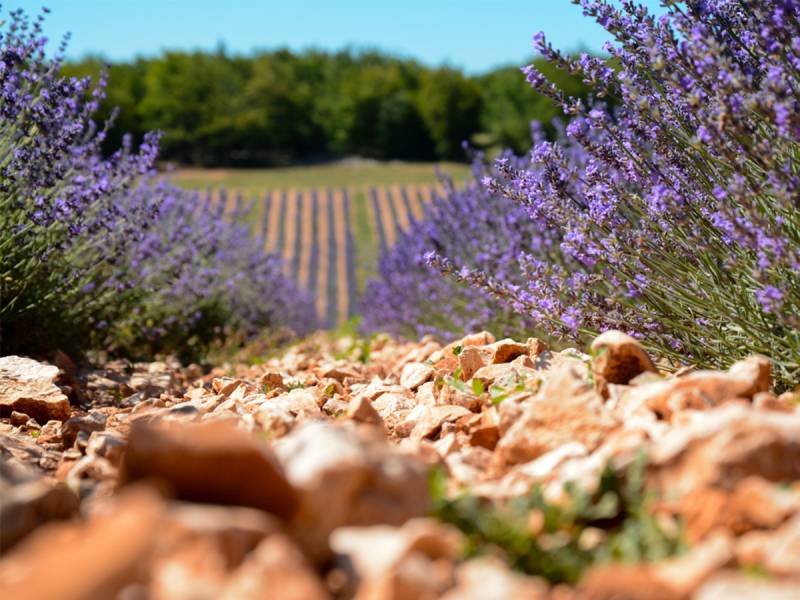
Its resistance to cold is remarkable, and the 1,100-metre altitude is ideal. It thrives in calcium-rich soils and dislikes acidic, clay-heavy, compact or waterlogged ground. Good sun exposure is essential for oil yield. Our terrain is therefore perfectly suited to it.
It benefits from rainfall when plants resume growth after planting, in May and June during flower formation, and at the end of summer when plants recover after harvest.
At Château du Bois, no cuttings are taken. Seeds from the current year are collected and sown directly in the ground during winter, thus respecting the plant's natural reproduction cycle across crop rotations.
Population fine lavender and direct sowing
The life cycle of fine lavender on our estate.
Fine lavender is endemic to Provence, where it reproduces by seed. Each year, thanks to bees that mix genes through pollination, new seeds are fertilised and fall to the ground at the end of summer.
These tiny lavender seeds remain dormant until winter, when a subtle combination of cold and humidity breaks their dormancy, allowing them to germinate in spring.
A baby lavender plant emerges from the soil, tiny and delicate — and it will be four years before it can be harvested for the first time.
After yielding its essence once a year every summer for six years, the "old" ten-year-old plants are uprooted in September after their final season.
At least two years must pass before sowing again — two years of green manure during which the soil rests under fallow with cereal crops (rye, triticale) and legumes (vetch) to nourish and structure the earth and stimulate microbial life between lavender generations.
The importance of population lavender
When lavender reproduces naturally through its seeds and the bees that mix its genes, it is called "population lavender" because each plant has its own genetic code — each one is unique, different from all its neighbours. This is natural, wild lavender.
Like most plants (and animals), lavender has been selected by humans who have guided its reproduction to obtain more resistant, more productive varieties, bluer ones (for bouquets), white ones for decoration...
These selected varieties are known as "clones" or "clonal lavenders".
Clones are most often reproduced by cuttings and lack the great genetic diversity of true population lavender. Varieties such as super bleue, bleu extra, maillette and matheronne are all clonal lavenders.
These clones are the ones cultivated in newer lavender-producing countries such as Bulgaria, where selection has been carried out to adapt fine lavender to terroirs different from that of Haute-Provence.
Why is population lavender essential oil better than clonal lavender?
Population lavender essential oil is richer and better balanced due to its genetic diversity. Since each plant has its own genetic code, each one produces an essential oil with a slightly different composition. When these oils are blended during distillation, they complement one another — the resulting essence is richer and better balanced, both in terms of properties and fragrance.
This is not the case with clonal lavender. A single genetic code reproduced by cutting across entire fields always produces the same oil — poorer in complexity, even when blended.
To try to reproduce the extraordinary olfactory signature of wild lavender, some clonal lavender producers grow several cutting varieties and create a "communelle" — blending essences from different clones to achieve something resembling a population oil, increasing complexity and richness.
Clever — but nothing compares to the natural genetic diversity of wild lavender, reproduced naturally in its native mountains.
Conclusion
Terroir and reproduction play a major role in the quality of fine lavender essential oil.
The blue gold of the region — a jewel for aromatherapy
The emblematic flower of Provence, fine lavender essential oil is the most widely used in aromatherapy, owing to its extensive range of properties.
It can help relieve:
- Insomnia (2 to 3 drops on the pillow), irritability (diffused in the air), headaches (massaged onto the temples), stress (5 to 6 drops in the bath). Lavender is calming.
- Wounds and burns (1 to 2 drops), dry eczema (2 to 3 drops on a cotton pad applied gently without rubbing), pressure sores, sunburn, insect bites. Lavender is antiseptic and promotes healing.
- Colds and sinusitis (1 to 2 drops inhaled). Lavender is anti-infective.
- Sore throats (1 to 2 drops on a sugar cube or a spoonful of honey).
- Muscle tension and rheumatism (a few drops massaged in). Lavender relaxes muscles and eases pain.
- Head lice (1 drop behind the ears as prevention), intestinal parasites (1 drop on a sugar cube for a 3-day course). Lavender is antiparasitic.
Important: all of these uses apply only to fine lavender (Lavandula angustifolia, population variety).
Author: Max Lincelé
Last updated : 04/02/26